LiDAR & Urban Thermal Comfort
Title
Human-Centric Approaches to Urban Thermal Comfort Perception: Leveraging Greenery and LiDAR in Dense Cityscapes
Description
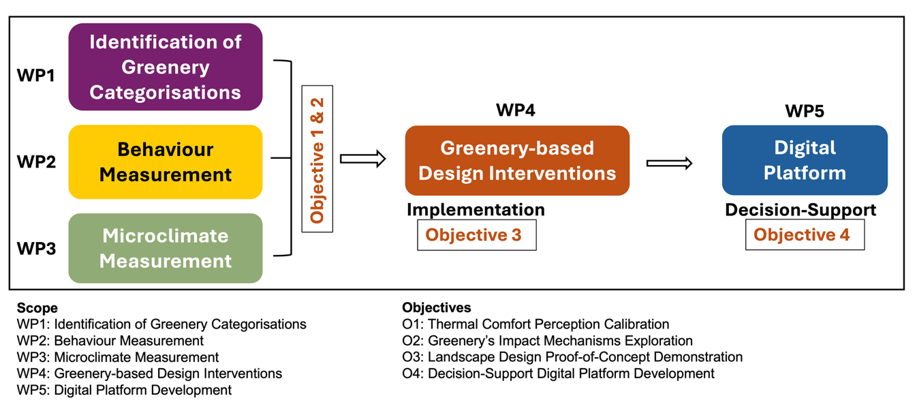
This study adopts a human-centric approach to examine how urban greenery influences thermal comfort perception across diverse land use types, urban forms, and socio-demographic groups in Singapore. We do this via advanced methods such as the deployment of LiDAR for both spatial as well as weather measurements coupled with human based surveys and longitudinal tracking. Although the cooling potential of greenery is well established, the mechanisms through which different greenery typologies, urban forms, and social factors interact to shape human thermal comfort perception remain poorly understood. Addressing this gap, the study seeks to (1) assess how greenery affects thermal comfort perceptions across diverse urban contexts; (2) explore the role of individuals’ prior exposure to greenery (thermal history) in shaping their thermal comfort perception; (3) identify effective greenery-based design interventions for enhancing thermal comfort in high-density environments; and (4) develop decision-support guidelines and digital platform to help stakeholders optimize greenery for improving thermal comfort at local and microscale levels.
Role
Co-Principal Investigator
Period
2026–2029 $ 1,399,864.70 SGD